
Experience that shaped the Operational Complexity Framework™.
Over three decades spanning military air traffic control, international tower operations, major airport leadership, humanitarian airlift, and FAA NAS modernization. The OCF wasn’t built in a conference room — it was built from real operational experience.
Patrick Air Force Base — military aviation in a launch-and-range environment.
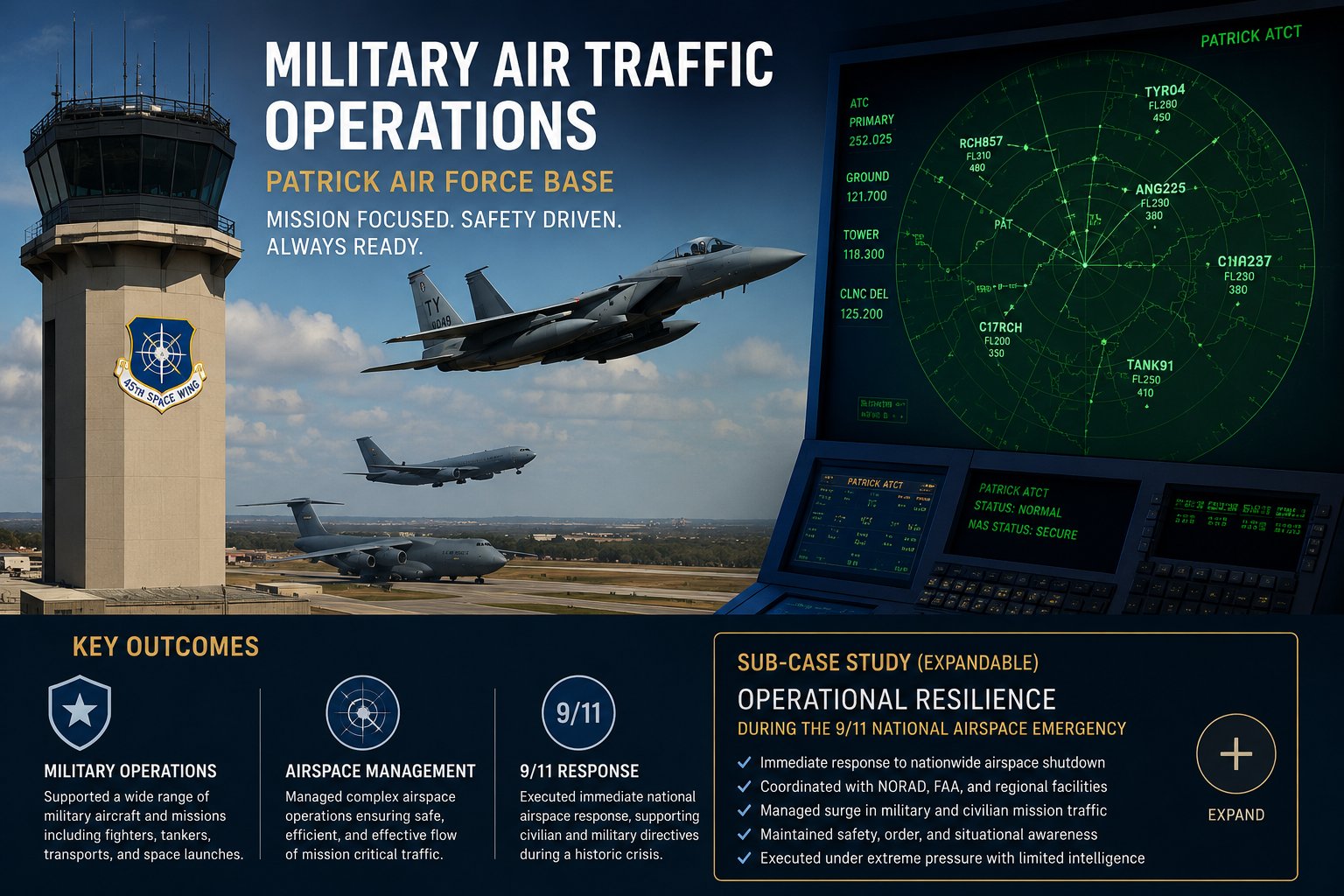
United States Air Force · 45th Operations Support Squadron · Patrick AFB (now Patrick SFB), Florida. Air Traffic Controller and Individual Mobilization Augmentee (IMA), US Air Force Reserve.
Support safe and efficient air traffic operations in a mission-critical Department of Defense environment supporting military flight operations, Eastern Range launch coordination, transient aircraft, rescue missions, and civilian NAS integration. Patrick AFB was a strategic aviation and space-operations hub along Florida’s Space Coast — not a routine military airfield.
Managed Class D airspace from the staffed control tower; applied FAA separation standards in radar-supported operations; coordinated with Orlando Approach Control and Jacksonville ARTCC; and integrated multi-service operations across two active runways (primary 03/21 at 9,008 ft) including transient military aircraft, rescue, and launch-related activity.
- Sustained safe air traffic operations across military, transient, and launch-related missions
- Maintained airspace integration with civilian NAS and adjacent FAA facilities
- Supported Eastern Range and Cape Canaveral launch activity
- Demonstrated high-performance decision-making under variable workload and mission conditions
Patrick AFB provided the foundational experience for the OCF’s Airspace Complexity, Human Performance, and Governance & Coordination domains. Operating at the intersection of military, civilian, and launch-related airspace is exactly the kind of multi-stakeholder operational complexity the framework now measures.
Embedded Sub-Case StudyOperational Resilience During the 9/11 National Airspace Emergency + Expand
Assignment. 45th Operations Support Squadron, Patrick AFB — Air Traffic Controller, Individual Mobilization Augmentee (IMA), US Air Force Reserve. Integrated directly into active-duty operations to support mission surges and national emergencies.
Challenge. On September 11, 2001, the National Airspace System experienced the largest operational disruption in US aviation history. Air traffic control facilities nationwide transitioned immediately from routine operations to emergency procedures as the FAA implemented the first nationwide ground stop — SCATANA-level coordination with NORAD, regional facilities, and military commands under extreme pressure and limited intelligence.
Approach. Executed immediate national airspace response coordination; managed surge in military and civilian mission traffic; maintained safety, order, and situational awareness; and operated under directives from civilian and military authorities through a historically unprecedented operational sequence.
- Immediate response to nationwide airspace shutdown
- Coordinated with NORAD, FAA, and regional facilities throughout the emergency
- Managed surge in military mission traffic following civilian airspace closure
- Maintained safety, order, and situational awareness under extreme operational stress
- Executed under extreme pressure with limited intelligence and rapidly evolving directives
This direct experience of operational saturation under emergency conditions is one of the experiential foundations of the OCF’s Operational Saturation Threshold™ (OST) construct.
Guam — managing aviation in a high-risk Pacific environment.
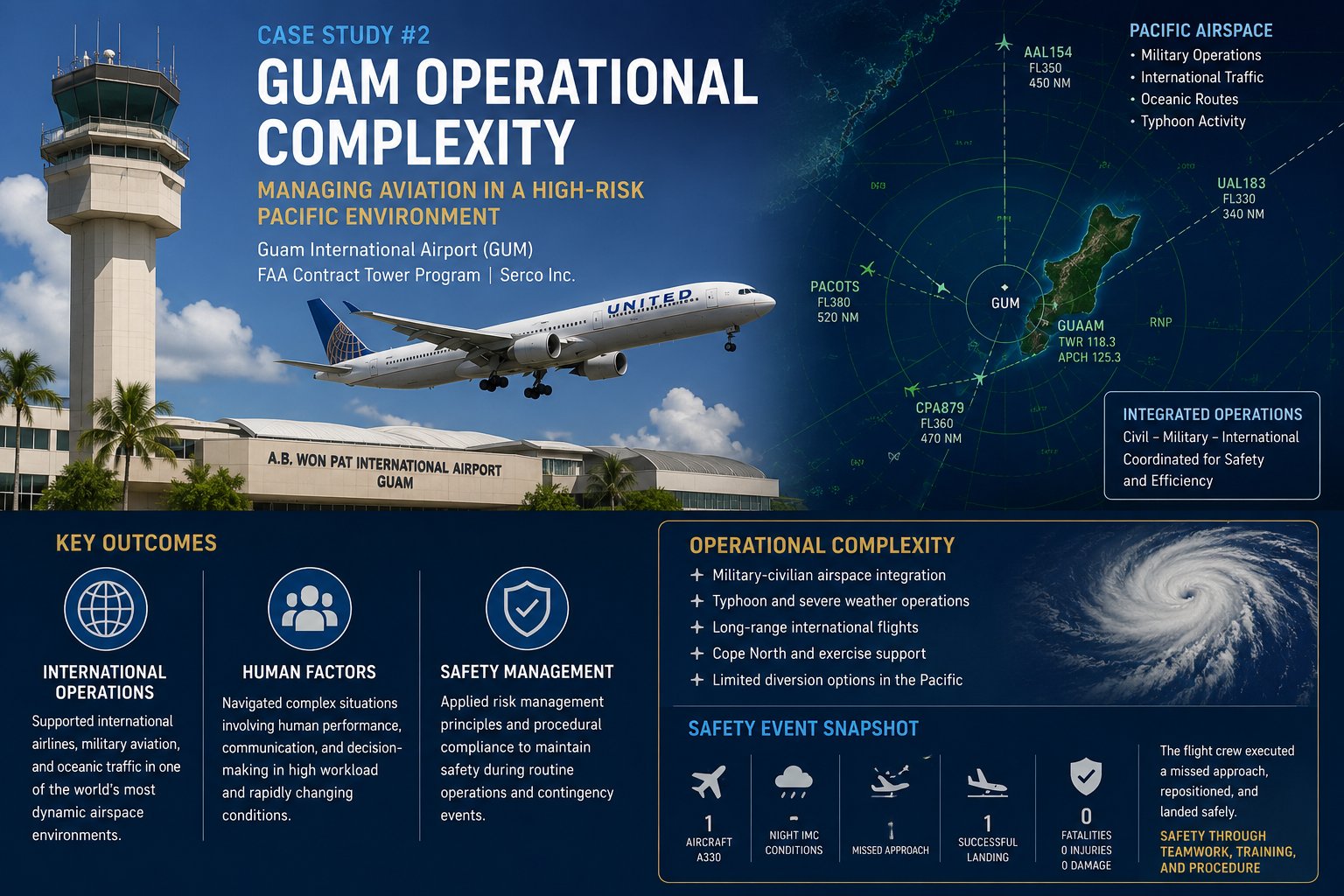
Federal Aviation Administration (FAA) FCT Program · Employer: Serco Inc. · Guam International Airport (Antonio B. Won Pat International), Mariana Islands. Air Traffic Controller, 2003–2005.
Support safe and efficient air traffic operations within one of the most operationally complex aviation environments in the Pacific region — continuous coordination across civilian controllers, military installations, international airlines, oceanic airspace users, and allied military forces operating across the Western Pacific.
Managed diverse aircraft types and rapidly changing weather in a uniquely integrated military-civilian aviation ecosystem; coordinated long-range oceanic and international flights; applied FAA separation standards through typhoon operations, military exercises (Cope North), and surge events; maintained operational continuity in a region with limited diversion options.
- Supported international airline, military aviation, and oceanic traffic in one of the world’s most dynamic airspace environments
- Navigated complex situations involving human performance, communication, and decision-making in high-workload conditions
- Applied risk management principles to maintain safety during routine operations and contingency events
- Documented safety performance through real operational events — including a missed-approach / successful-landing sequence under night IMC with zero injuries or damage
Guam shaped the OCF’s Human Performance Complexity, Environmental Complexity, and Safety & Risk Complexity domains. Working a high-tempo international tower in a typhoon-prone Pacific environment with limited diversions is a daily lesson in how environment, workload, and risk compound.
Orlando Sanford — growth, regulatory compliance, and humanitarian airlift.
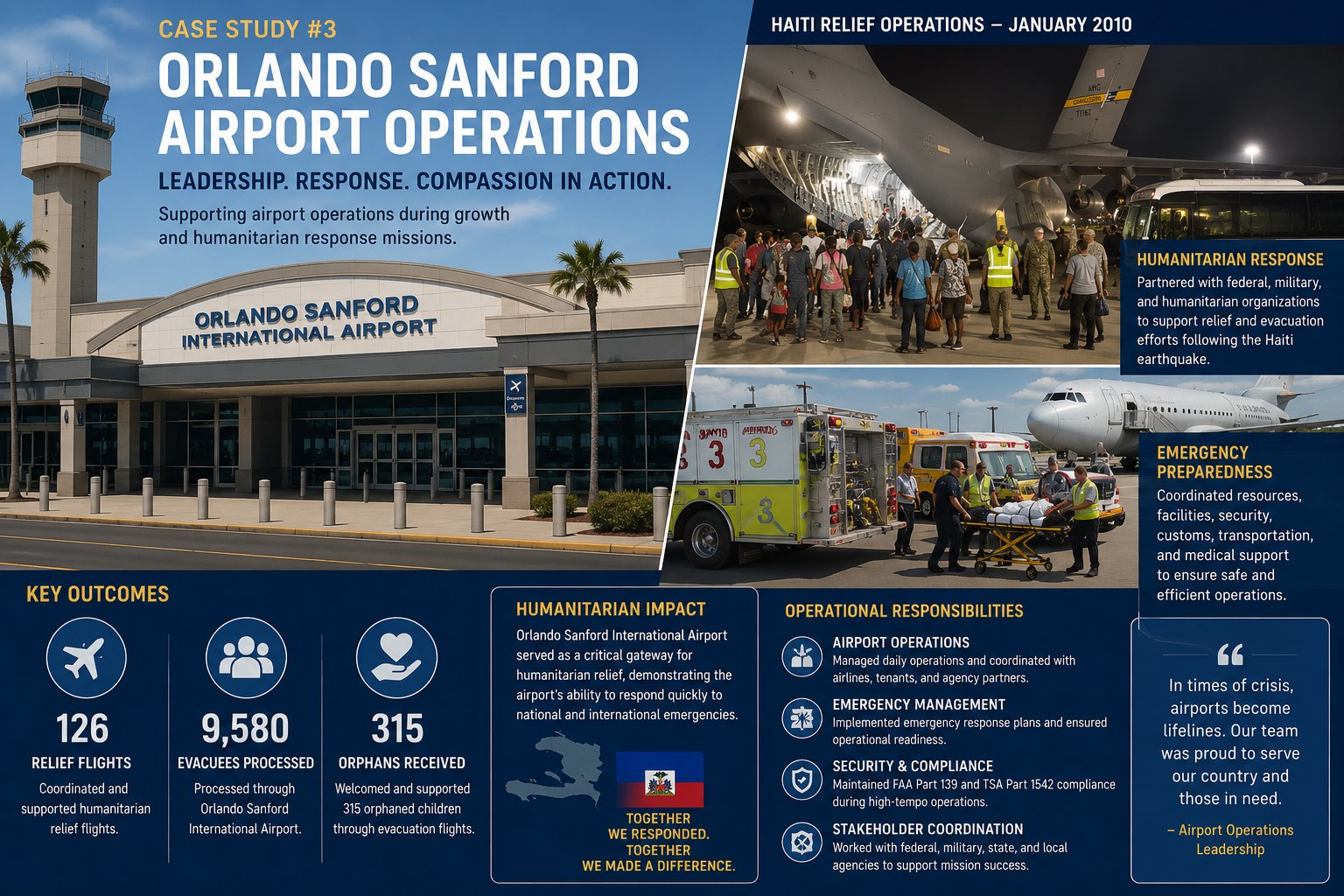
Orlando Sanford International Airport · Airport Operations Manager, 2005–2010. A growing commercial service airport in Central Florida supporting domestic and international airline operations, general aviation, air cargo, and emergency response activities.
Balance operational efficiency, regulatory compliance, customer service, emergency preparedness, and stakeholder coordination during sustained passenger growth, infrastructure development, evolving TSA requirements, and major humanitarian response operations — under strict FAA Part 139 and TSA Part 1542 oversight.
Managed daily operations and coordinated with airlines, tenants, and agency partners; implemented emergency response plans; maintained FAA Part 139 and TSA Part 1542 compliance during high-tempo operations; coordinated with federal, military, state, and local agencies; partnered on the Haiti earthquake relief operation as the airport became a critical gateway for evacuation, orphan reception, and humanitarian airlift.
“In times of crisis, airports become lifelines. Our team was proud to serve our country and those in need.” — Airport Operations Leadership
Orlando Sanford shaped the OCF’s Infrastructure Complexity, Public Interface Complexity, and Governance & Coordination domains — particularly the principle that complexity compounds during simultaneous growth, regulatory, and emergency operations.
BWI Marshall — large-hub operations, infrastructure expansion, regulatory scale.
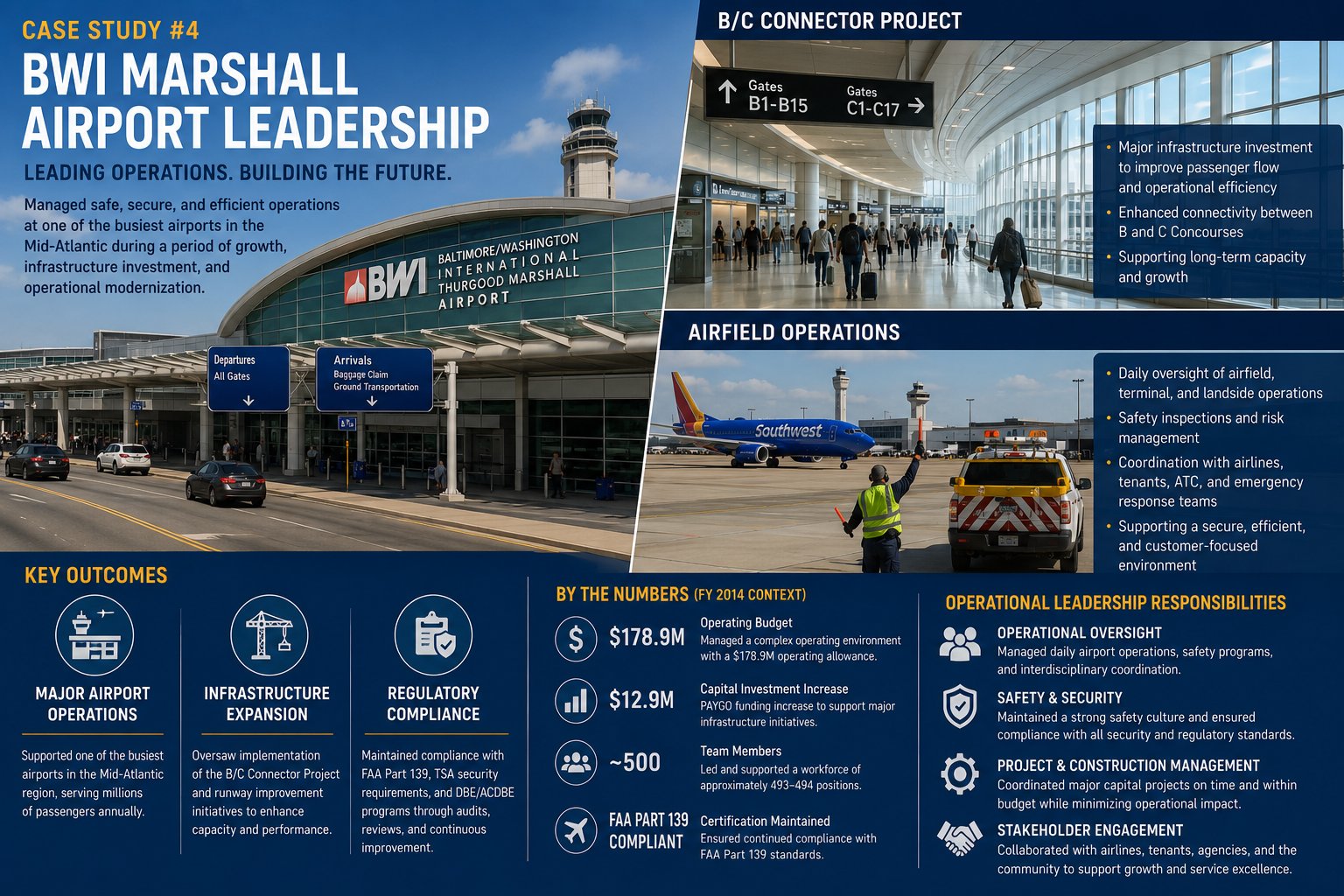
Maryland Aviation Administration (MAA) · Baltimore/Washington International Thurgood Marshall Airport (BWI Marshall). Airport Operations Manager, 2014–2018. Responsible for managing operations at BWI Marshall and Martin State Airport.
Support safe, secure, and efficient operations at one of the busiest airports in the Mid-Atlantic during sustained passenger growth, major infrastructure investment (B/C Connector Project, runway improvements), regulatory oversight, and operational modernization.
Daily oversight of airfield, terminal, and landside operations; safety inspections and risk management; coordination with airlines, tenants, ATC, and emergency response teams; managed major capital projects (B/C Connector Project) on time and within budget while minimizing operational impact; sustained FAA Part 139, TSA, and DBE/ACDBE compliance through audits, reviews, and continuous improvement.
- Sustained full FAA Part 139 compliance during major infrastructure expansion
- Coordinated B/C Connector Project — major passenger-flow and capacity infrastructure
- Enhanced operational safety and inspection reliability
- Improved stakeholder coordination across airlines, tenants, ATC, and maintenance teams
BWI Marshall shaped the OCF’s Infrastructure, Governance & Coordination, and Security domains — particularly the recognition that complexity at major hubs is rarely a single-domain problem; it’s the simultaneous interaction of capital projects, regulatory oversight, and high-volume operations.
FAA / Leidos NISC — aeronautical data integrity and NAS modernization.
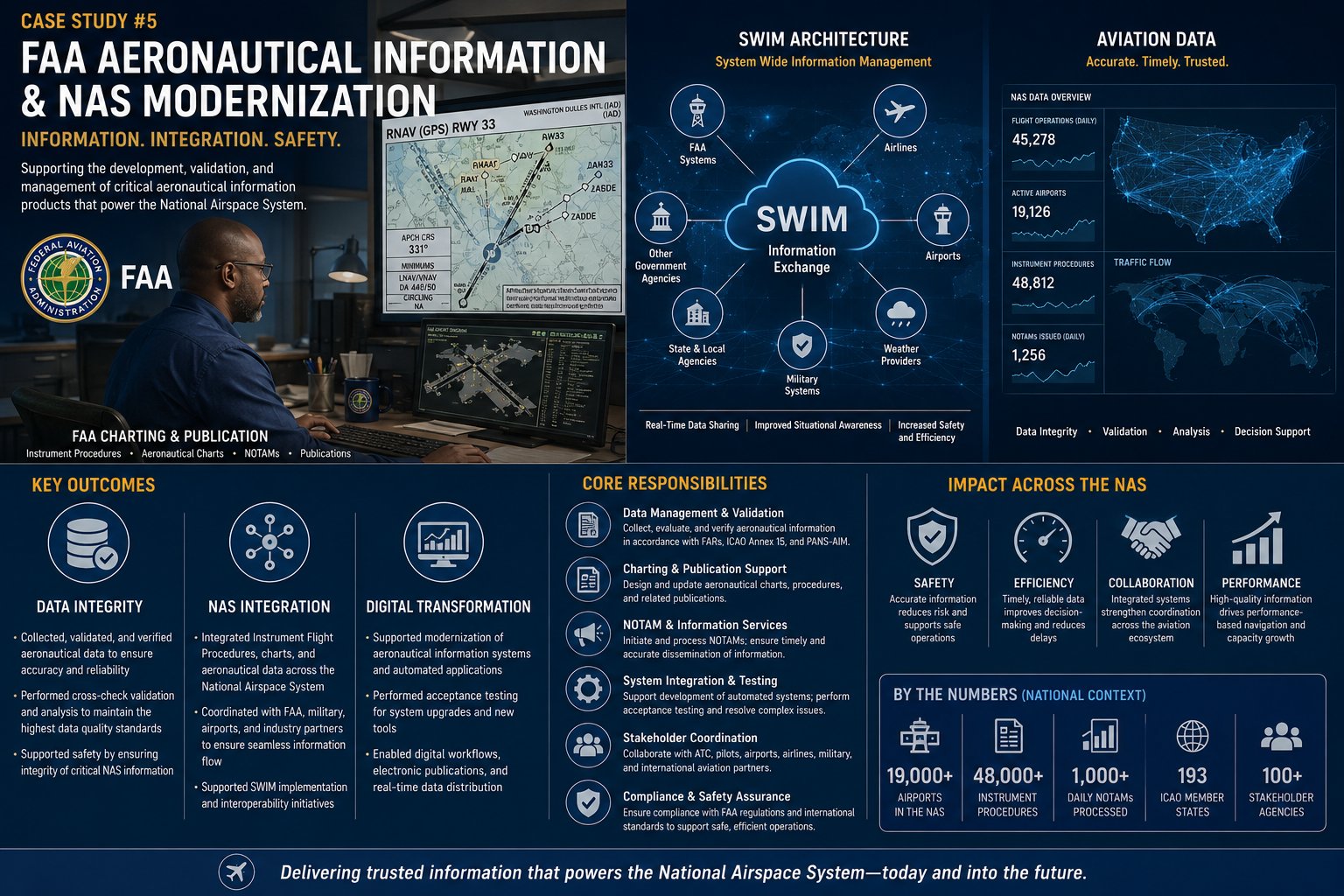
Federal Aviation Administration (2010–2014) and Leidos Inc. on the FAA NISC Program (2019–Present). Aeronautical Information Specialist (FG-13 equivalent). Supports development, validation, integration, and maintenance of aeronautical information products used throughout the NAS.
Aviation operations are increasingly dependent on digital information, automation, performance-based navigation, and real-time data exchange. Maintaining data integrity and operational accuracy is mission-critical: errors in aeronautical data propagate directly into flight procedures, charting, and operational safety.
Coordinated across FAA Air Traffic Organization (ATO), Air Traffic Control facilities, Flight Procedures Teams, airports, airlines, ICAO partners, and 100+ stakeholder agencies. Supported System Wide Information Management (SWIM) implementation; conducted data validation, cross-checks, and QA aligned to FARs, ICAO Annex 15, and PANS-AIM. Supported charting & publication, NOTAM services, system integration testing, and compliance assurance across the NAS.
- Data integrity sustained across FARs, ICAO Annex 15, and PANS-AIM compliance frameworks
- Integrated Instrument Flight Procedures, charts, and aeronautical data across the NAS
- Supported SWIM (System Wide Information Management) implementation and interoperability
- Enabled digital workflows, electronic publications, and real-time data distribution
- High-quality information driving performance-based navigation and capacity growth
FAA NAS modernization shaped the OCF’s Technology & Systems Complexity and Emerging Aviation Integration domains — aviation data is the substrate every other domain runs on. The framework treats data integrity, integration, and information management as a complexity driver in its own right.
Five careers, one continuous lens on operational complexity.
Military aviation. International tower operations. Major airport leadership. Humanitarian airlift. Federal NAS modernization. Each experience sharpened a different dimension of how operational burden actually behaves. The OCF is the methodology that emerged.
Explore the Operational Complexity Framework™ →Ready to apply the framework to your environment?
Request an Operational Complexity Assessment™ and receive an OCI score, heat map, executive briefing, and prioritized action roadmap.